Satya Nadella published a piece over the weekend on how AI changes the firm. I read it twice. It is one of the better things written on the subject, and I don't say that lightly given how much AI commentary is flooding every feed right now.
His central argument is that the real AI opportunity isn't picking the best model. It's building a learning loop on top of models, one that absorbs your organization's judgment and compounds it over time. He calls this the compounding of human capital and token capital.
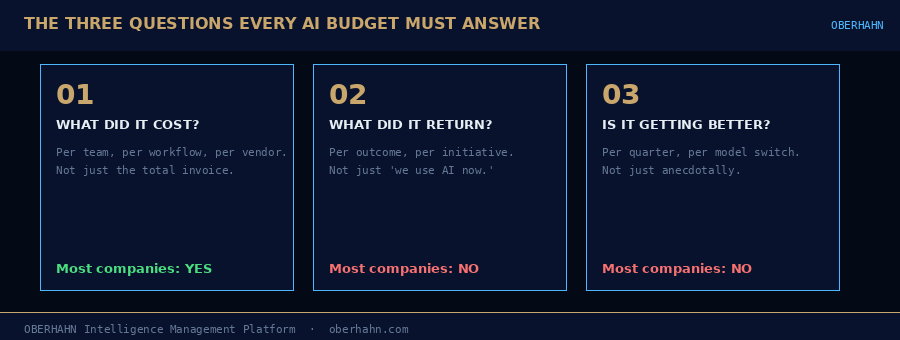
But there is a condition his piece leaves unnamed, and it is the one that determines whether any of the compounding actually happens. Most organizations I talk to cannot answer a simple question: what does your AI investment actually return? Not as an estimate. Not as a story you tell the board. Per task, per workflow, per team, per decision. The ones who can answer it are about to understand why it matters more than any model benchmark they've ever run.
The Unanswered Question Inside the Learning Loop
A loop only compounds if someone is keeping score. Satya describes a system where your AI gets better with each use, where private evaluations capture whether the model is improving, where institutional memory becomes queryable. That is a real and powerful vision. But it has a prerequisite his piece doesn't name: you need a way to measure what each unit of AI output actually returned to the business.
Not better in aggregate. Better against what outcome, at what cost, per task, per workflow, across which teams. Without that granularity, the loop is running but the business cannot read the results. The machine is climbing. Nobody knows which hill.
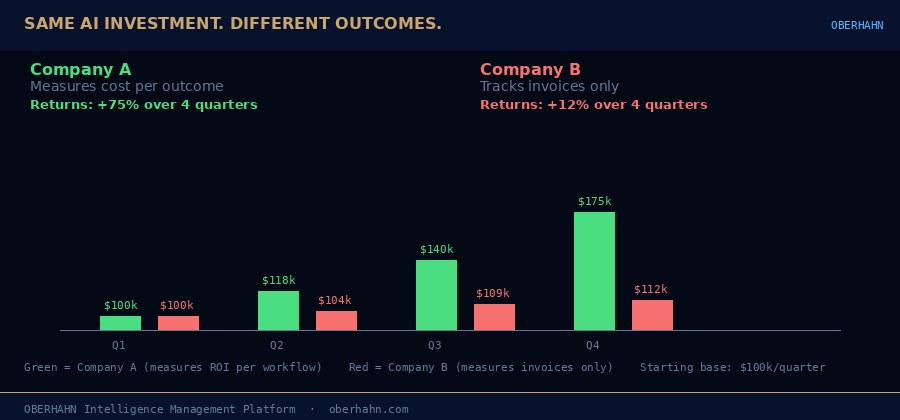
I keep seeing the same pattern. Two organizations at the same maturity point, comparable AI investment, similar tooling. One is measuring what each workflow returns: cost per resolved ticket, per shipped feature, per classification run. The other is managing to the invoice total.
Within a few quarters the gap between them is not subtle. The architecture is identical. The measurement discipline is the competitive advantage. Satya's learning loop is real. But a loop without a scoreboard is just motion.
Control Requires a Scorecard
One of Satya's most important points is that a company should be able to switch generalist models without losing the institutional expertise built into their systems. That is the right framing. But switching models without knowing how each one performs against your own specific outcomes isn't control. It is preference dressed up as strategy.
Model portability means nothing if you cannot compare models on your own numbers. Cost per task, cost per workflow, output quality per use case, improvement over time per decision type. Without that data, you are making a vendor decision, not an intelligence decision. Most organizations can tell you what they spend on AI. Almost none can tell you what each workflow returns. That gap is where Satya's vision stalls in practice.
I had a conversation a few months ago with a head of engineering at a mid-sized financial services firm. They had been running GPT-4 across four internal workflows for about a year. Smart team, real deployment, genuine usage. When a cheaper model became capable enough to handle two of those workflows, they had no way to know which two. They had invoices. They did not have outcomes. They made a gut call. That is not institutional intelligence compounding. That is the same guess dressed in better infrastructure.
Compounding Shows Up on the P&L or It Does Not Exist
Satya describes the learning loop as the new IP of the firm. A hill climbing machine where every improved workflow generates a better training signal, which accelerates the accumulation of knowledge unique to that organization. That is a genuinely useful frame. The question it leaves open is how you know the machine is climbing versus wandering.
Efficiency gains are real outcomes. Faster resolution, lower cost per transaction, better decisions made in less time. But those need to be traceable back to specific AI investments or they exist only as intuition. Unverified intuition is not institutional knowledge. It is a belief without proof.
The model your support team needs is probably not the model your data science team should be running. Document classification at scale has different economics than generating customer-facing copy, and both are different from code review. Most organizations treat model selection as a vendor decision made once. The ones generating real returns treat it as a performance question they revisit every quarter, with the same rigor they apply to any other capital allocation. Cost per task by model. Output quality per use case. Improvement rate by workflow. Those are the numbers that tell you whether your learning loop is actually climbing, or just running. I think of this as the Outcome Layer, the instrumentation that sits between what your AI does and what your business actually needs to know about it. Without it, the loop Satya describes is architecturally sound and strategically blind.
We Are Already Building This
At Oberhahn, the problem we built for is exactly this one. Not dashboards. Not invoice aggregators. The infrastructure that connects what an organization spends on AI to what it actually gets back, by task, by workflow, by team, by outcome. So that the decisions about where to invest next are business decisions and not guesses.
Satya is right that the learning loop is the new IP of the firm. What that means in practice is that the organizations that build measurement into that loop from the beginning will own it. The ones that don't will build something they believe in but cannot defend. Your AI investment should make your company more powerful. Oberhahn makes that visible.The organizations that will own the next decade of AI aren't the ones that deployed fastest. They're the ones that knew what they were getting for it. That distinction will matter more as models commoditize, as the intelligence gap between providers narrows, and as the real competition shifts from capability to operational leverage. The firms that built measurement into their AI from the beginning will compound that advantage every quarter. The ones that didn't will spend the next two years trying to retrofit visibility into systems that were never designed to produce it.
At Oberhahn, the problem we built for is exactly this one. Not dashboards. Not invoice aggregators. The infrastructure that connects what an organization spends on AI to what it actually gets back, by task, by workflow, by team, by outcome. So that the decisions about where to invest next are business decisions and not guesses.
Satya is right that the learning loop is the new IP of the firm. What that means in practice is that the organizations that build measurement into that loop from the beginning will own it. The ones that don't will build something they believe in but cannot defend. Your AI investment should make your company more powerful. Oberhahn makes that visible.