Why are so many AI companies building their products around a single model when the model landscape changes every month? I've been sitting with that question for a while, and I don't have a clean answer.
What I do have is a growing suspicion that the AI industry has been solving the wrong problem. I was talking to a founder recently who had built an impressive product on top of a single model provider. Smart team, real traction, good unit economics. Then the provider changed their pricing. Margins collapsed overnight. The rewrite took three months. He told me it felt like finding out your factory was built on someone else's land.
We've been obsessed with model intelligence: which model scores highest, which one reasons better, which one writes cleaner code. Those are real questions worth asking. But I think the bigger story, the one that will actually determine who wins, is model flexibility.
In the 1970s, most Western manufacturers looked at Toyota and saw an efficiency story. Less walking between machines. Less inventory piling up on the floor. Less waiting between production steps. The consultants flew to Japan, toured the factories, took notes, and came home with a checklist. Reduce waste. Tighten the line. Move faster.
They had observed the right factory and drawn the wrong conclusion. What Toyota had actually built wasn't a more efficient system. It was a more adaptable one. The efficiency was a byproduct. The real innovation was a factory floor that could absorb change without breaking. That distinction sounds subtle. It isn't. One is an optimization. The other is a philosophy.
I think Toyota was actually solving a different problem than efficiency. The question they were answering was this: how do you build a system that performs well when the future is uncertain? That reframe matters, because uncertainty doesn't go away when you optimize harder. It just finds new ways to break your assumptions.
Every production system falls into one of three categories, and I've started calling this framework the Flexibility Factory. Fixed factories are optimized for one set of conditions and perform well until something changes. Flexible factories can absorb variation without redesigning the whole workflow. And adaptive factories don't just respond to change, they're built to reconfigure around it automatically. Most manufacturers thought they were building flexible systems. Toyota was building the third kind. Most AI companies today think they're building flexible systems too.
To understand why Toyota's insight matters for AI, it helps to understand the three types of production systems they were working against.
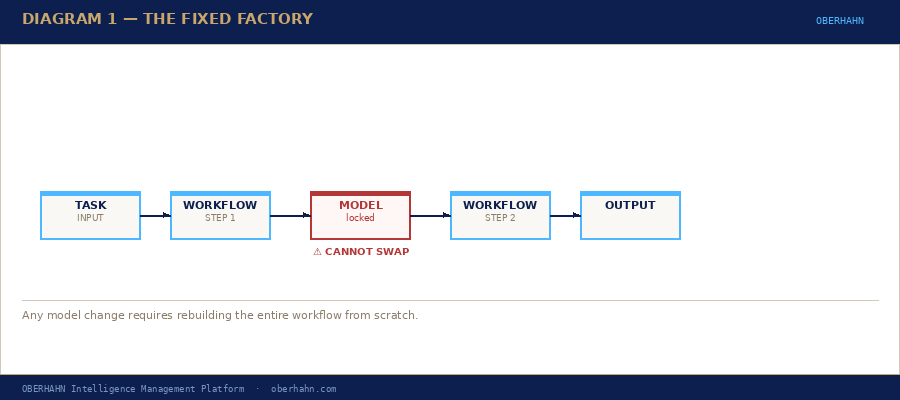
A fixed factory is optimized for one set of conditions. The machinery is tuned, the workflow is tight, and output is predictable. The problem is that conditions always change eventually. Demand shifts, a supplier raises prices, a key input becomes scarce. When that happens, a fixed factory doesn't bend. It breaks. Most AI applications today are fixed factories disguised as software, built around a single model, a single pricing assumption, and a single set of performance expectations.
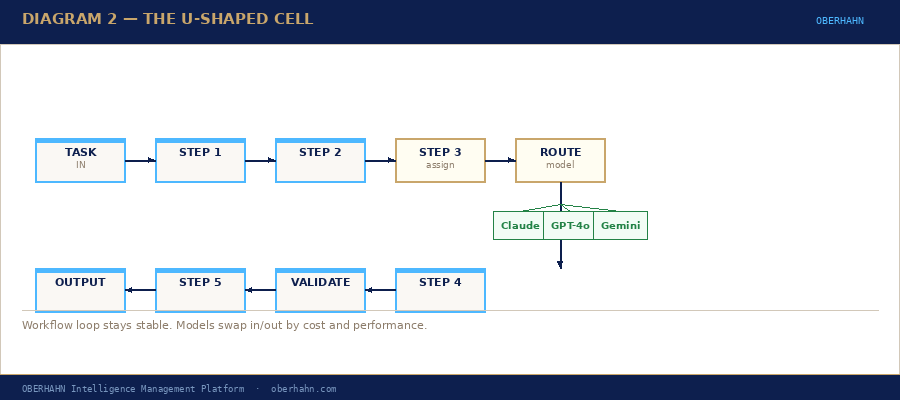
A flexible factory changes the relationship between the system and the machine inside it. Toyota's U-shaped production cells are the clearest example. Workers could be added or removed from a cell without redesigning the workflow around them. The process stayed constant while the capacity inside it could change. That required a fundamentally different way of thinking about what the factory was actually for.
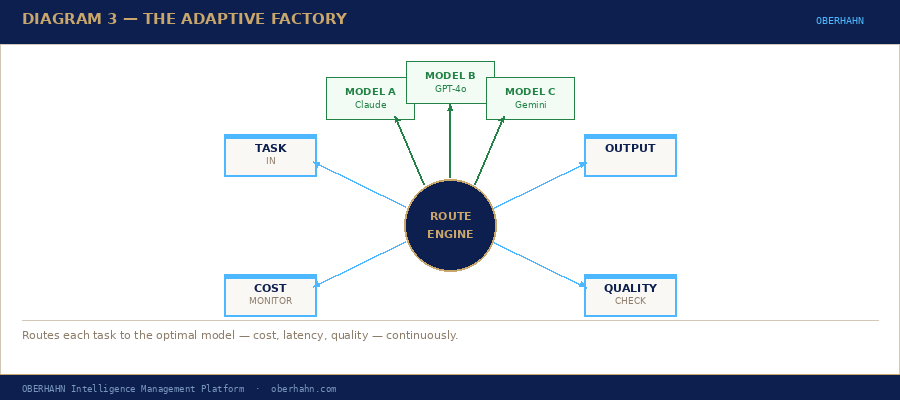
The third category is the adaptive factory. These systems are designed around the assumption that change is constant. Rather than absorbing disruption, they reconfigure around it automatically. The factory itself becomes optimized for volatility. Most manufacturers never reached this stage, and most AI companies won't either, unless they start asking harder questions about how their systems are structured from the beginning.
Most AI applications today are built with the workflow and the model tightly coupled. The logic of your product assumes a specific model, a specific response format, a specific cost structure. When the model changes, and it will, the workflow breaks. That's not an engineering problem your team needs to solve. That's a strategic decision you made at the design stage, whether you knew it or not.
A model abstraction layer creates the AI equivalent of Toyota's U-cell. You build your workflow around a stable interface, and any model can sit behind it. GPT, Claude, Gemini, an open-source model running on your own infrastructure. The workflow never needs to know which machine is doing the work, and more importantly, your business never gets held hostage by the pricing, availability, or performance decisions of a single vendor.
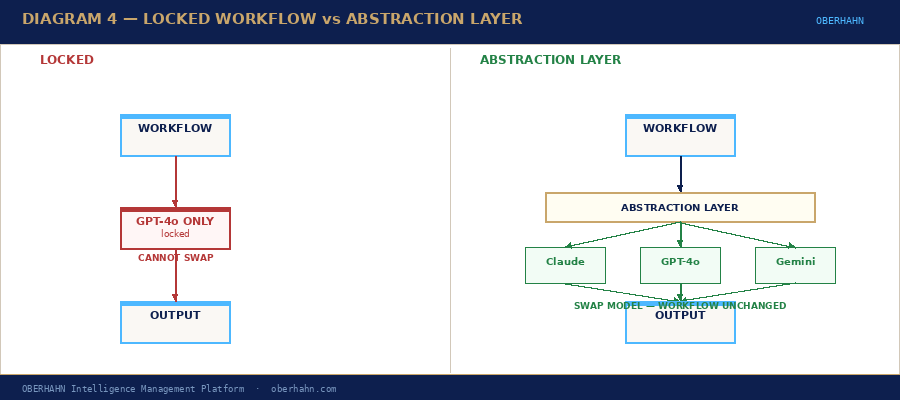
The companies that understand this early will have a structural advantage that compounds over time. Your product is the workflow, the logic, the experience you've built for your customers. The model is infrastructure. The moment you treat it as anything more than that, you've handed a critical lever of your business to someone else. The Flexibility Factory isn't a technical pattern. It's a strategic one.
Every AI system is balancing three variables at all times: cost, capability, and efficiency. Cost is how much the model runs you. Capability is whether it can actually accomplish the task. Efficiency is whether it's the right tool for that specific job, not just a capable one. Most teams pick a model that scores well on capability and stop there. The other two variables don't show up until they become a problem.
Building around a single model means accepting whatever tradeoffs that model makes across all three. When the cost goes up, you absorb it. When a cheaper model becomes capable enough, you can't easily switch. When a faster model would serve your users better, your architecture won't let you move. That's not a technical constraint. That's a business constraint you built yourself.
There's a simple way to know what kind of factory you've built. If GPT goes down, what happens to your product? If Claude doubles in price tomorrow, how does that change your margins? If an open-source model becomes capable enough to handle your core workflow, can you switch without a rewrite? Most teams don't love their answers to those questions. That's not a criticism. It's just an honest read of where the industry is right now.
The first wave of AI was about finding the best model. Teams ran benchmarks, picked a winner, and built on top of it. That was a reasonable strategy when the landscape was new and the gaps between models were large. Those gaps are closing fast, and the variable that's starting to matter more isn't which model you picked. It's how your system handles the moment that model is no longer the right answer.
Model volatility is now a permanent condition, not a phase the industry is passing through. The Flexibility Factory framework exists because of that reality. Organizations that internalize this early won't just survive model transitions. They'll use them as leverage while their competitors scramble.
Toyota didn't win because it built the most efficient factories. It won because it built factories that could adapt faster than everyone else. Efficiency was the outcome. Adaptability was the strategy. The companies that studied Toyota and copied the efficiency missed the point entirely, and most of them are gone now.
The same shift is happening in AI, and I think it will move faster than anyone expects. Models are becoming labor. Workflows are becoming factories. The intelligence arms race that has defined the first wave of AI will give way to an infrastructure war, and the winners of that war will be determined not by which model they're running today, but by how quickly they can change their minds tomorrow.
We're still early enough that most teams can make this shift before it costs them. But the window is closing. The first wave of AI rewarded speed. The next wave will reward structure. Build your factory accordingly.