Anthropic announced recently that Claude can now join Slack as a team member. It builds memory across conversations, works asynchronously, schedules its own tasks, and takes initiative without being prompted. It is a genuinely significant moment, and most of the coverage treated it as a product story.
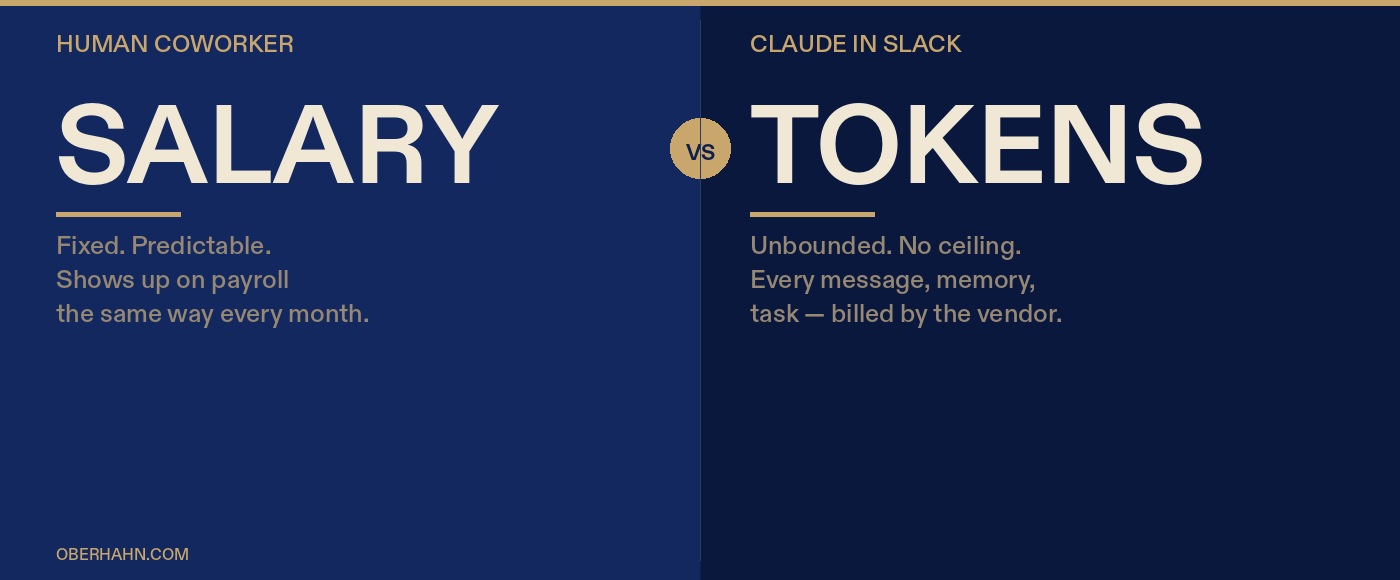
The part nobody said out loud is the token implication. A human coworker has a salary. A fixed, predictable cost that shows up on payroll the same way every month. Claude has unbounded tokenized activity. Every message, every memory built, every asynchronous task initiated, every workflow it touches across your organization runs through a vendor's billing system with no ceiling attached to it.
Until now, most organizations were counting API calls from a handful of engineering workflows. That was a manageable accounting problem. What Anthropic announced last week is a different one entirely. You are now tokenizing cognitive labor across your entire organization, and the frameworks most companies use to manage that spend were not built for what it has become.
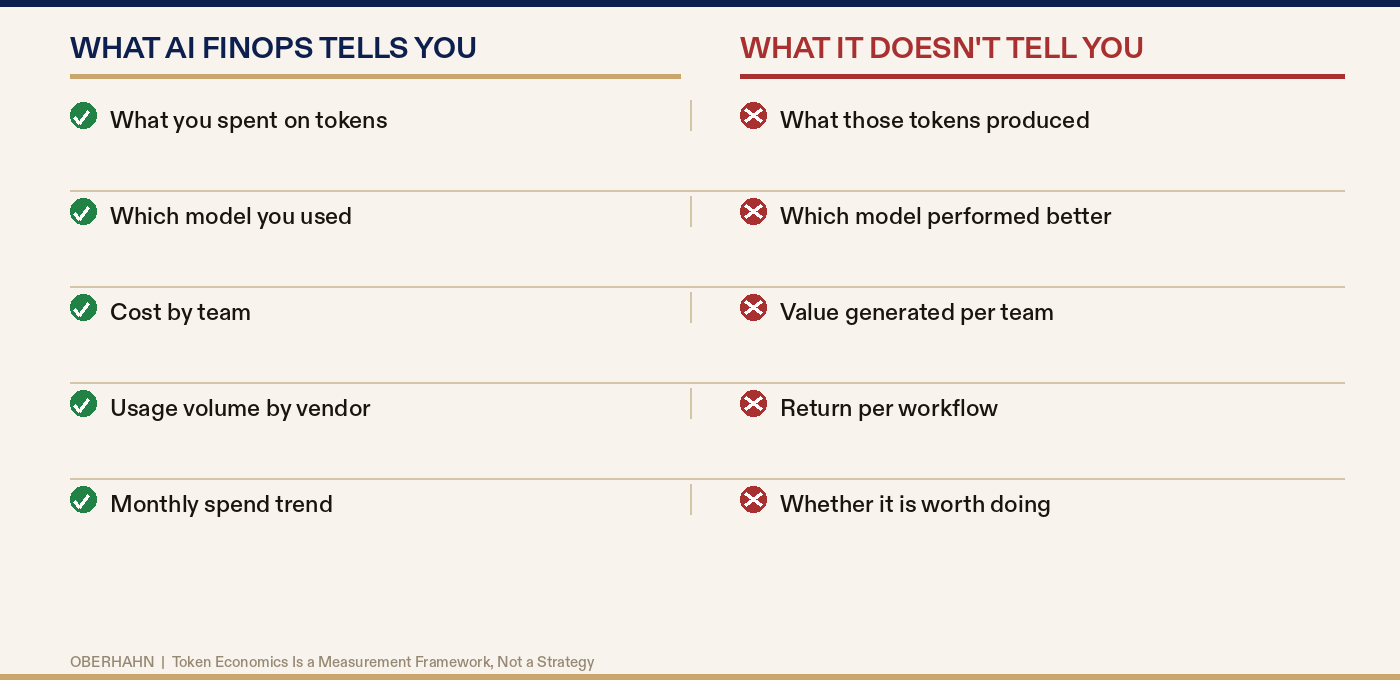
The practice of AI FinOps is real and necessary. Cost per token, allocation by team, spend by model, workload forecasting. The discipline exists because the problem is real, and the organizations building it are ahead of the ones still managing to the invoice total. But AI FinOps answers one question well: what did we spend?
Knowing your fuel cost per mile tells you something important about your fleet operations. It doesn't tell you which routes are generating revenue, which ones should be cut, or whether the car should be running at all. The measurement is the precondition for a strategy. Most organizations are treating it as the strategy itself.
An organization that can tell you exactly what it spent on tokens last quarter but cannot tell you what those tokens produced is not managing AI. It is managing an invoice. Those are different problems, and solving for one while ignoring the other is how organizations end up with cost discipline and no competitive advantage to show for it.
Satya Nadella, CEO of Microsoft and one of the most influential voices on enterprise AI adoption, has argued that organizations should own their institutional expertise independently of any model. The real AI opportunity, in his framing, isn't picking the best model but building a learning loop on top of models, one that absorbs your organization's judgment and compounds it over time. The organizational knowledge is the asset. The model is infrastructure. That framing is correct, and it has a dependency his piece leaves unnamed.
You cannot make an intelligent model swap without knowing how each model performs against your own workflows. Token economics tells you cost per model. It says nothing about output per model, outcome per workflow, or return per dollar invested across your actual operations. I keep coming back to the same pattern: organizations that have invoices but not outcomes. When a cheaper model becomes capable enough to handle a core workflow, they have no way to know which workflow. They make a gut call. That is not institutional intelligence compounding. That is the same guess dressed in better infrastructure, and it compounds into a strategic liability as the number of workflows grows.
The frontier model capability gap is closing faster than most organizations have adjusted for. OpenAI, Anthropic, and Google are converging at the top. Nobody has a durable moat on raw intelligence anymore. The moat is the system built around the model: the workflows, the institutional knowledge, the feedback loops that make output more valuable over time. Building that system requires knowing what the model produced per task, per workflow, per team. Not just what it cost.
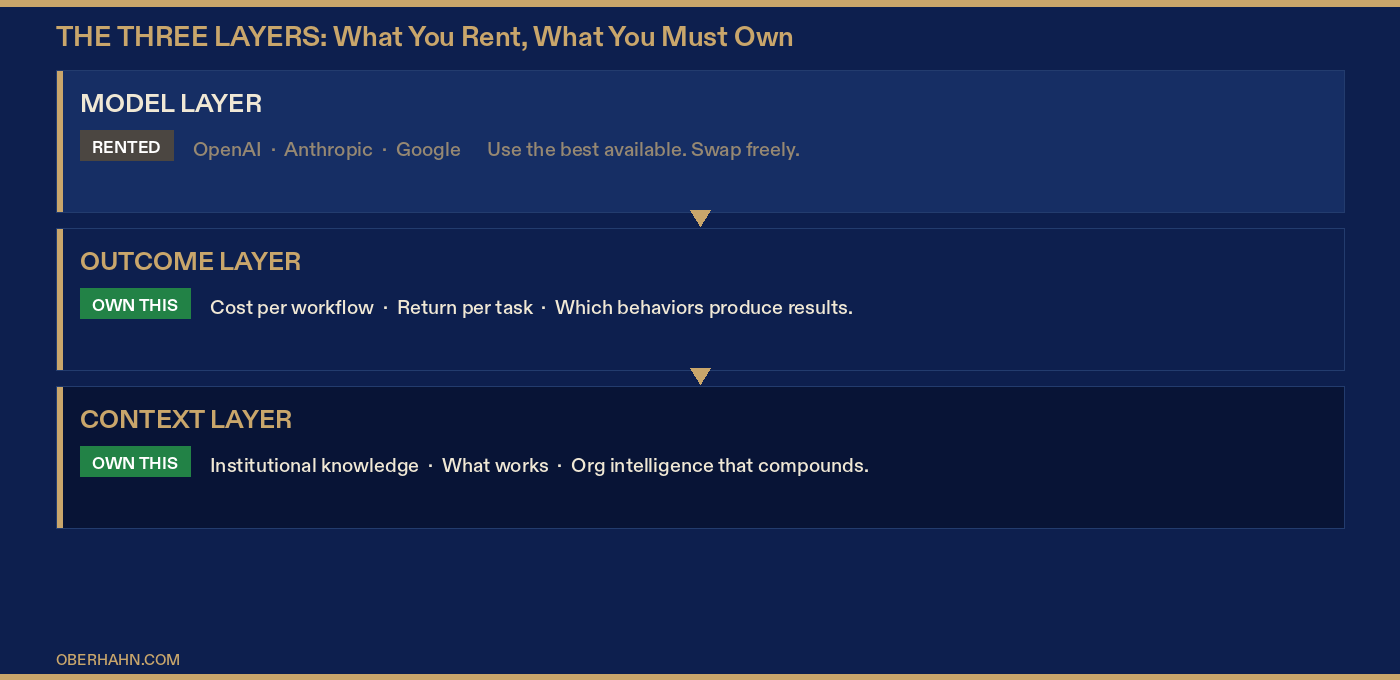
Anthropic isn't trying to lock you in through model quality. The capability gap is closing and they know it. What they're building with Claude in Slack is something more durable: ownership of the context layer.
Once Claude is a shared team member with memory of your channels, your exception paths, your unfinished threads, your institutional decision-making patterns, you are no longer renting intelligence. You are renting your company's operating memory. Models can be swapped. Agents can be copied. But the memory of how your company actually works, the accumulated context of thousands of asynchronous interactions across every team, is much harder to move. Maybe impossible. That memory lives in Anthropic's infrastructure, priced by the token, and it compounds every week you stay.
This is a more sophisticated moat than any capability advantage because it is built from your own organizational knowledge rather than theirs. The defense isn't refusing to use Claude in Slack. The productivity is real and walking away from it is its own kind of loss. The defense is owning the intelligence layer yourself, knowing what your AI environment produces per task, per workflow, per team, before any single vendor owns that knowledge on your behalf. The organizations that build that visibility first will have something no model swap can take away.
The organizations that get beyond token economics aren't doing something exotic. They're applying the same measurement discipline to AI that they apply to every other capital allocation. Cost per resolved ticket. Cost per shipped feature. Cost per workflow, per team, per outcome. The unit changes depending on the function. The principle doesn't.
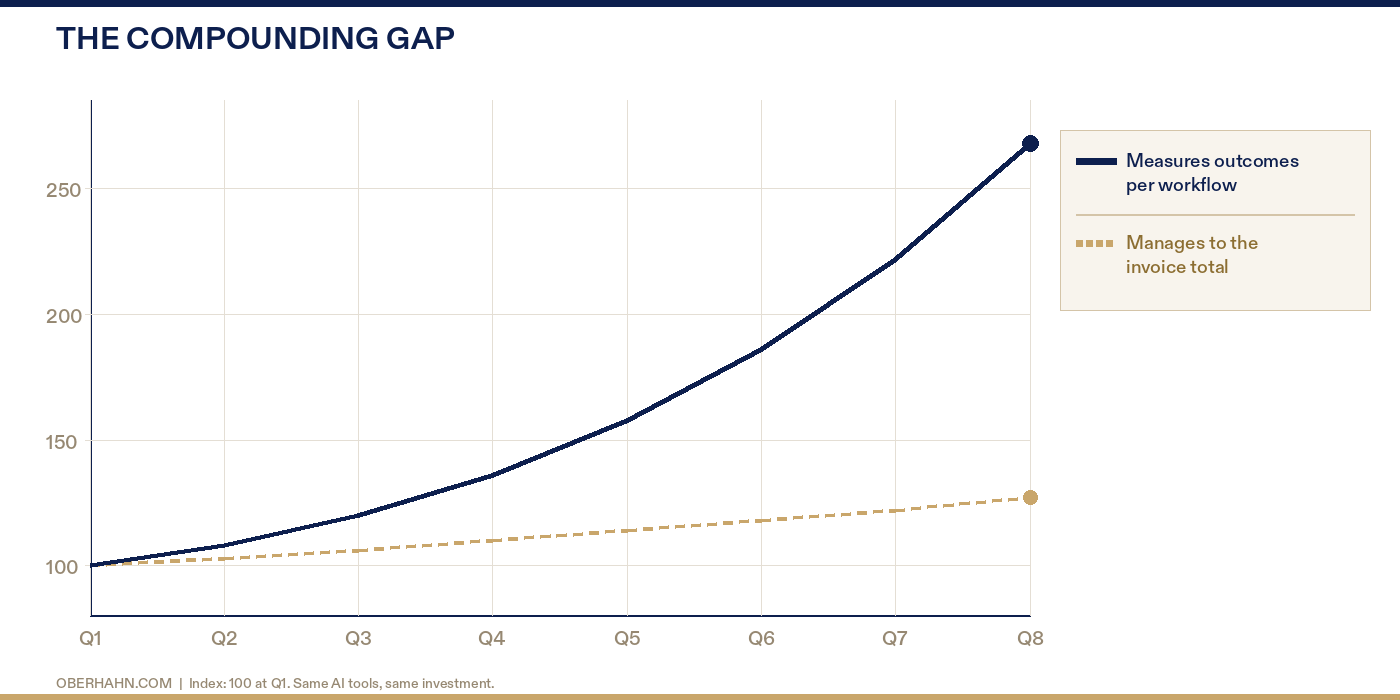
I think of this as the outcome layer: the instrumentation that sits between what your AI does and what your business actually needs to know about it. Without it, the learning loop Satya describes is architecturally sound and strategically blind. A loop without a scoreboard is just motion. I keep seeing the same pattern play out. Two organizations at the same maturity point, comparable AI investment, identical tooling. One is measuring what each workflow returns per task, per workflow, per team. The other is managing to the invoice total. Within a few quarters the gap between them is not subtle, and it widens every quarter because measurement compounds the same way the learning loop does.
Token economics is the accounting system for AI. It is essential, it is necessary, and every organization running AI at scale needs it. But accounting systems are backward-looking by design. They answer to finance. They tell you what you burned. They do not tell you what you built.
With Claude now operating as a shared team member across organizational memory, and frontier models converging fast enough that nobody holds a durable capability advantage, cost visibility alone is not a defensible position. The organizations that win will be the ones that own the context and the outcomes. The intelligence layer and the measurement layer. Both.
Rent the intelligence from whoever is best this month. Models will keep improving, pricing will keep shifting, and loyalty to any single provider is a liability dressed up as a preference. But own what the intelligence produces. Per task, per workflow, per team, per decision. That is the asset. And unlike the model underneath it, it doesn't belong to anyone else unless you let it.
The organizations that build the outcome layer first will be able to switch models on performance data, not vendor preference. They'll scale the workflows that are earning and cut the ones that aren't. And when the board asks what the AI investment returned, they'll have an answer that doesn't require a story. At Oberhahn, that's the infrastructure we're building: the layer between what your AI environment costs and what it actually produces, so that every decision about where to invest next is grounded in something real.